
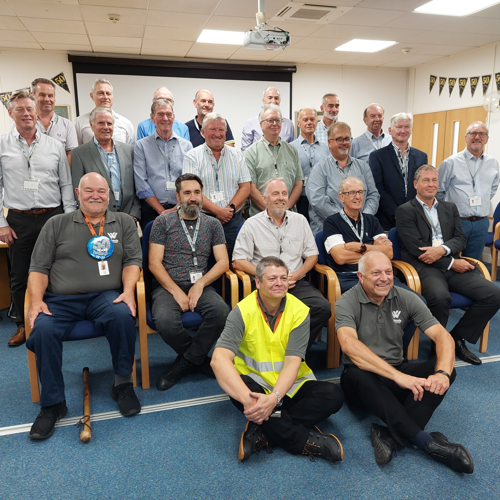
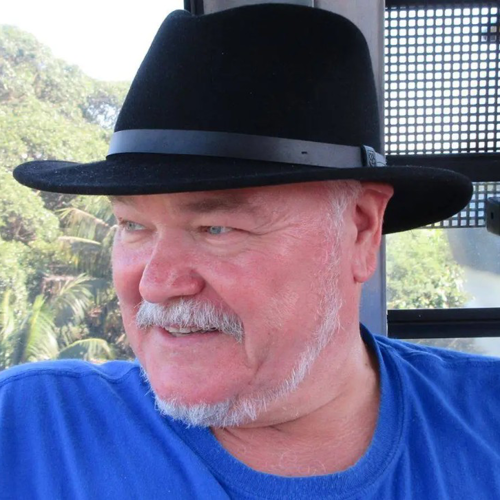
Ahead of his 70th birthday this April, we sat down with Peter Hunnaball to talk through a career that spans more than five decades at Woods Air Movement.
He joined the company in 1972 as an apprentice in the Acoustic Laboratory and, more than five decades later, now works as Technical Manager. In that time, both the business and the industry have changed significantly. What hasn’t changed, at least in Peter’s telling of it, is the importance of the people around you.
Peter’s first year wasn’t spent in the lab at all, but in the company’s training school - something that was standard for apprentices at the time.
“We all went through the training centre for the first year,” he says. “It was about learning machining, different trades, and really just getting used to working.”
It was also a shift in environment that was hard to miss. “You go from being a schoolchild to working in a place with nearly 2,000 people. You grow up very quickly.”
Woods’ training setup stood out locally. “It was quite unusual in Colchester to have that kind of system. The instructors were very good - they knew what they were doing - and it gave you a solid grounding.” Despite the size of the company, the atmosphere felt approachable. “It was a big place, but it was always friendly.” There was, he adds, the usual kind of humour aimed at apprentices. “You’d get sent off to stores for a tin of elbow grease, things like that,” he says. “All the typical tricks. But it was never anything more than that - it was all in good fun.” For Peter, that sense of fairness mattered. “I’ve always had a pronounced limp because I had polio when I was two,” he says. “There was always the chance people could have made something of that, but they didn’t. It was just a good place to work.”
When asked how the company compares to when he started, Peter points first to how the work itself has changed. “There were more people then,” he says. “But the work was far more manual.” Much of what is now automated or supported by modern systems was once done by hand, requiring a different kind of day-to-day understanding. “It was more physical, more hands-on. You had to approach things differently.”
Over time, Peter moved into more senior roles, but one change stands out as particularly difficult. “Going from being a lab engineer to managing the lab,” he says.
The technical side, he explains, wasn’t the issue. “You can learn the technical work. You can study it, understand it, and apply it. Managing people is the difficult part,” he says. “You’re dealing with different personalities, different ways of working. You have to be aware of people, be considerate, understand how they tick. That’s not something you can just pick up from a book.”
It’s a point he returns to more than once - that the human side of the job is often the most complex.
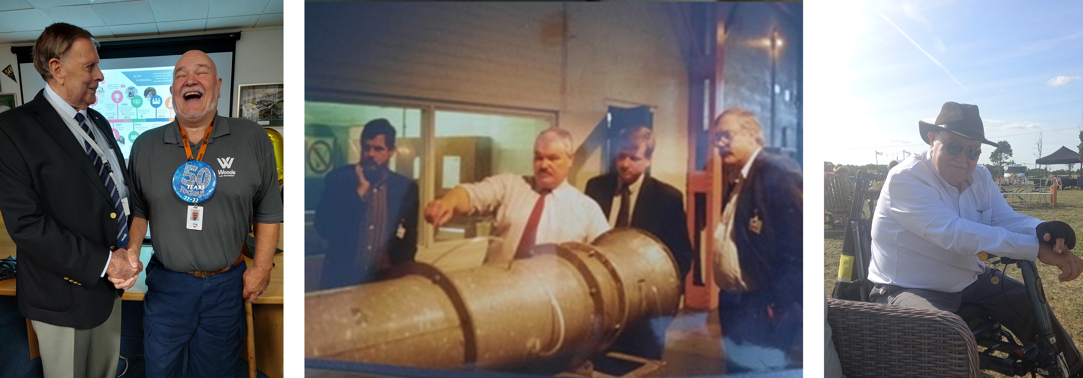
Across more than five decades, Peter has worked on a wide range of projects. Some have been large, some smaller, but one in particular stands out. “The Jubilee Line Extension in London,” he says. “That was a big job at the time - it played a part in opening up Canary Wharf.”
But again, what he remembers most isn’t just the scale of the project itself. “It’s the people you meet. I’ve still got friends from working on that,” he says. “That’s what stays with you.”
As Peter approaches his 70th birthday, he remains an active part of the business in his role as Technical Manager. Over 54 years, he has seen the company change in many ways - from how the work is carried out to the size and structure of the organisation - while still recognising the same sense of continuity in the people and the working environment.
After more than half a century at Woods Air Movement, Peter’s contribution is difficult to summarise neatly. It sits somewhere between the technical work, the projects, and the people he’s worked with along the way. But it’s there - in the business, and in the people within it.
And as he reaches 70, it feels like the right moment to say thank you.
 UK Site
 US Site